Husna and Mashia are pre-service primary teachers in their final semester of the Bachelor of Primary Education at the University of Sydney. This article provides fresh ideas for primary teaching, covering content for Stage 1.
Part 1
We draw on research on embodied learning that can be integrated to support student learning about human sense organs in the new K-6 Science and Technology syllabus. The article describes pedagogical strategies and activities to make learning interactive, engaging and meaningful for stage 1 students. Learning activities relate to the content ‘The human body’s sense organs detect its environment’ and ‘Recognise that the human brain detects information about the surroundings using sense organs ….’ (NESA, 2024). Central to this point is learning about the senses (sight, smell, touch, taste, hearing) that students already know, to understand more about the vital role senses play in collecting information about their surroundings. Students begin to understand that senses do not only affect personal experiences but are vital tools for survival.
Activities 1 and 2 explore how the eye and ear work (function) at a fundamental level. The focus is on stimulus type, how it is gathered from the environment and key parts only. Activity 3 introduced shared gestures to support vocabulary related to the sense of touch.
Eyes are light collectors
This embodied learning activity focuses on knowledge that eyes collect light to enable vision, a key idea fundamental to understanding how eyes sense our surroundings.
Materials
- Streamers (10)
- Toy
- Torch
- Printed picture of the toy
Provoke
Teacher question: would you be able to see a plant in a dark room with no light? Discuss, noting students’ ideas. Explain: we are going to embody (act out) how our eyes help us to see and think about how they work.
Embody
This is a whole-class activity where students physically represent a model of the eye (Figure 1). Students will each be given a role: light source, toy, light rays, eye parts (outside, lens, iris, optic nerve), brain.

Figure 1 - Embodied eye model
- Student holding the torch turns it on - representing a light source (e.g. Sun)
- Student holding the toy wiggles it - representing light rays reflecting off the toy.
- Three students representing light rays will travel side-by-side in straight lines from the toy to the gap (pupil) in the front of the eye.
- Two students representing the lens push the three light rays close together (focusing them) so they touch a small part on the light sensitive back of the eye (retina – optional).
- Immediately the back of the eye is touched one student acting as the optic nerve steps towards and ‘high fives’ the person representing the brain (symbolises message delivery).
- The ‘brain’ student holds up the toy picture (showing message has been received and processed) indicating the object can now be 'seen'
Ponder
Teacher asks critical thinking questions:
- What do our eyes collect that allows us to see?
- What would happen if a person:
- has their eyes closed?
- has a faulty optic nerve?
- Why can’t we see without light?
- How does being able to see help protect us from danger?
Safety considerations
- Ensure no tripping hazards.
- Safe torch use - avoid shining the light directly into eyes.
- Remind students holding the streamers to walk slowly (no running) - place cones if necessary to direct students' paths
Ears are vibration collectors
This embodied learning activity focuses on knowledge that ears collect vibrations to enable hearing, a key idea fundamental to understanding how ears sense our surroundings.
Materials:
- Metal container for each group - (e.g. empty cookie tin, small lunch tin, or metal can)
- Worksheet with table to record observations
Provoke
Teacher asks: ‘How do our ears know what is going on around us?’ Students contribute ideas. Introduces the term ‘vibrations’ and check students realise that sound is caused by vibrations. Rattle a container, ask: How can you tell this is making a sound?’ ‘Where must the vibrations go for you to hear it?’ ‘What happens when the vibrations reach you?’
Explain: we are going to embody (act out) how our ears catch vibrations to help us hear and think about how they work.
Embody
This is a whole-class activity where students physically represent a model of the ear (Figure 2). Students will each be given a role: sound source, sound vibrations, ear lobe, ear canal, ear drum, inner ear, auditory nerve, brain.
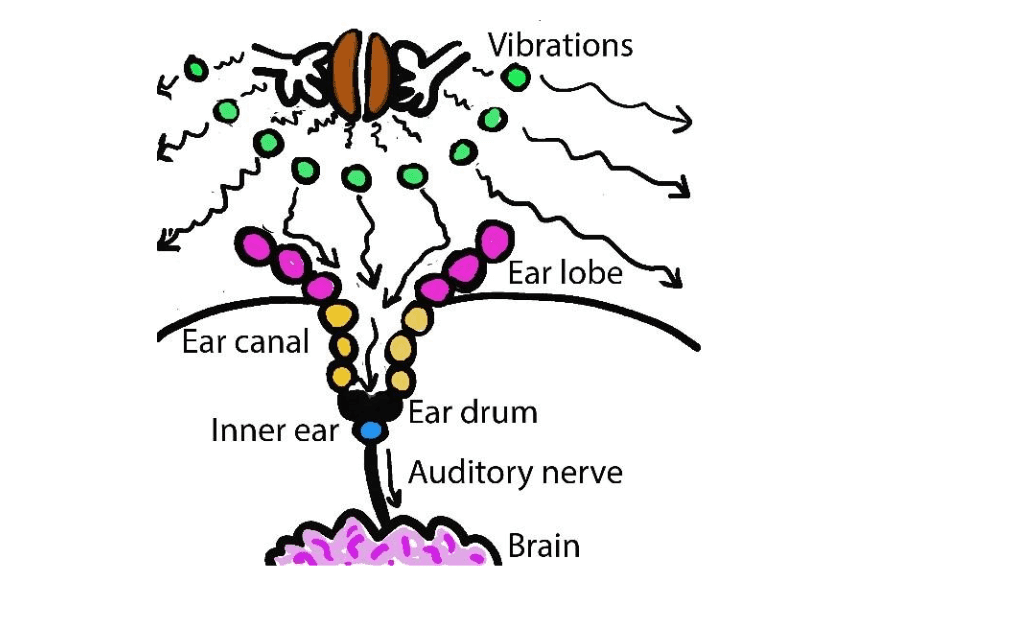
Figure 2: Embodied ear model
One student is the sound source (e.g. bangs cymbals together), nine students are vibrations, six students represent the ear lobe to ‘catch’ the sound (guide vibrations into the ear). Another six students are the ear canal who help the vibrations move along. Two students as the eardrum shake to represent transfer of the vibrations, they both tap the Inner Ear student who turns around before crouching down and stepping towards the brain (auditory nerve). They clap hands with the ‘brain’ student representing message reception. The ‘brain’ says ‘clang’ to show the message was decoded as a sound.
Teacher guides students in whole class discussion regarding the role of the ear parts and how they work together to gather sound to send a message to the brain which interprets this information.
Representation
Students record their observations in a table.
Students show their understanding visually by drawing arrows to represent how sound travels. They draw the sound’s journey: ear lobe → ear canal → eardrum → inner ear →brain, using symbols like wavy lines for vibrations, a circle for the eardrum, and a head for the brain.
Discussion questions:
- What were the different ear parts we modelled?
- What are vibrations?
- How does the ear get vibrations to the brain?
- What did each part do?
Safety Considerations:
- Monitor behaviour (gentle pushing, hand clapping and slow movements)
- Ensure students have space to move when acting.
Skin collects physical feelings
Students explore different textures through hands-on experiences, by feeling various objects and drawing them as well as representing textures with hand gestures.
Materials:
- Box
- Objects with different textures
- Hand Sanitiser
Part 2
Teacher asks ‘How do we know what something feels like if we can’t see it?’ Teacher explains ‘our skin collects different stimuli – contact, heat, pressure, movement, moisture, texture and send signals to our brains that it interprets as comfort, irritation, or pain. Fast messages (reflexes) help keep us safe. The skin is important for detecting much information about our surroundings.
Activity
The teacher displays a box filled with different textured objects. Individually students close their eyes, reach inside the box and choose an object. Students will explore the object with their hands using their sense of touch to try to identify the object.
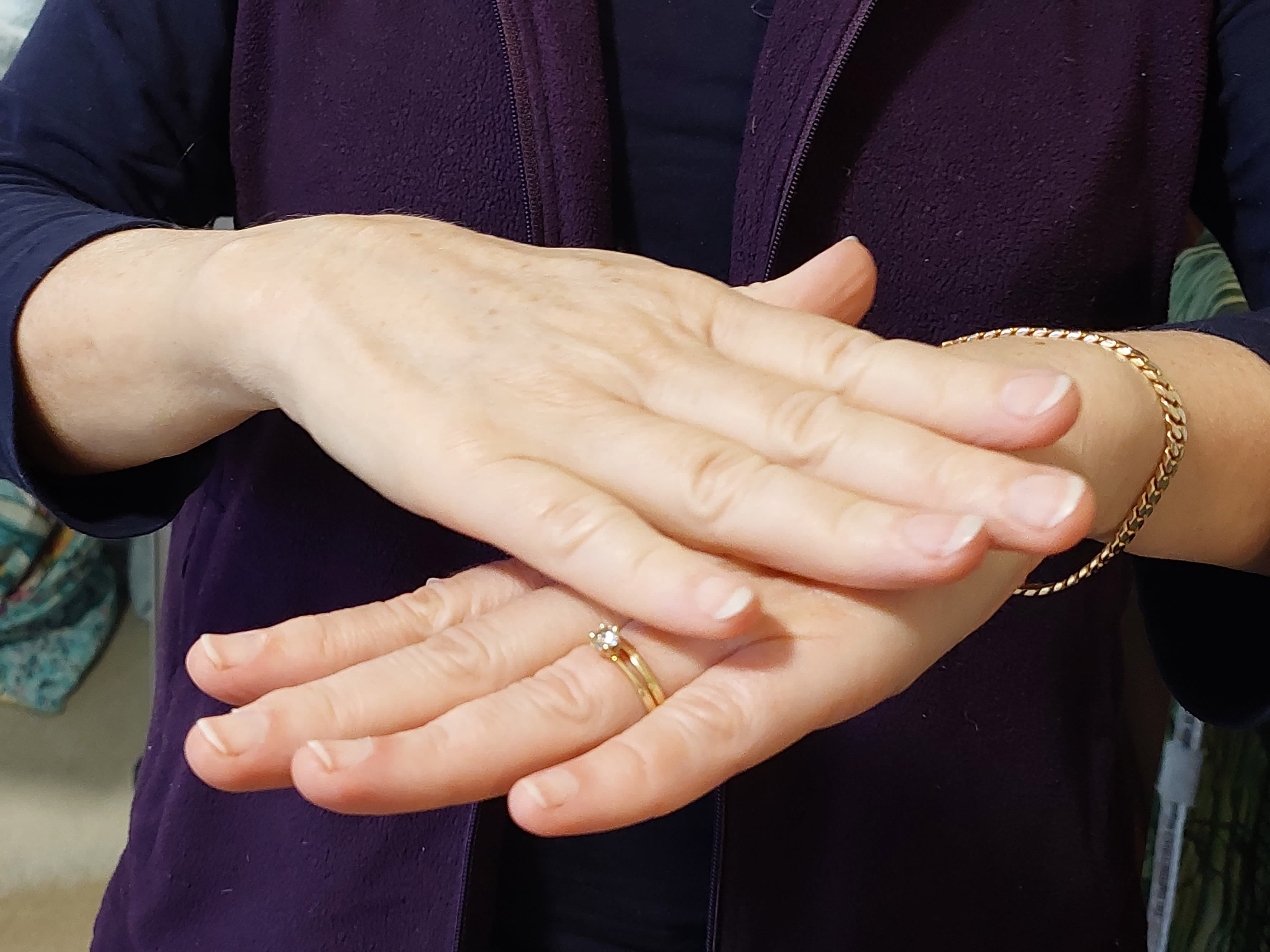
After their turn, each student will describe what clues their fingers (skin) gave them about the object. Teacher introduces discrete gestures to represent each texture, such as:
- Smooth: With hands flat, glide the top hand over the other hand (Figure 3)
- Bumpy: Touch your knuckles together and rub one hand up and down (Figure 4)
- Spongy: Squeeze your hands together and push in and out (Figure 5)
- Rough: Rub hands together while pressing hard (Figure 6)
The whole class will then use these actions to embody each texture:
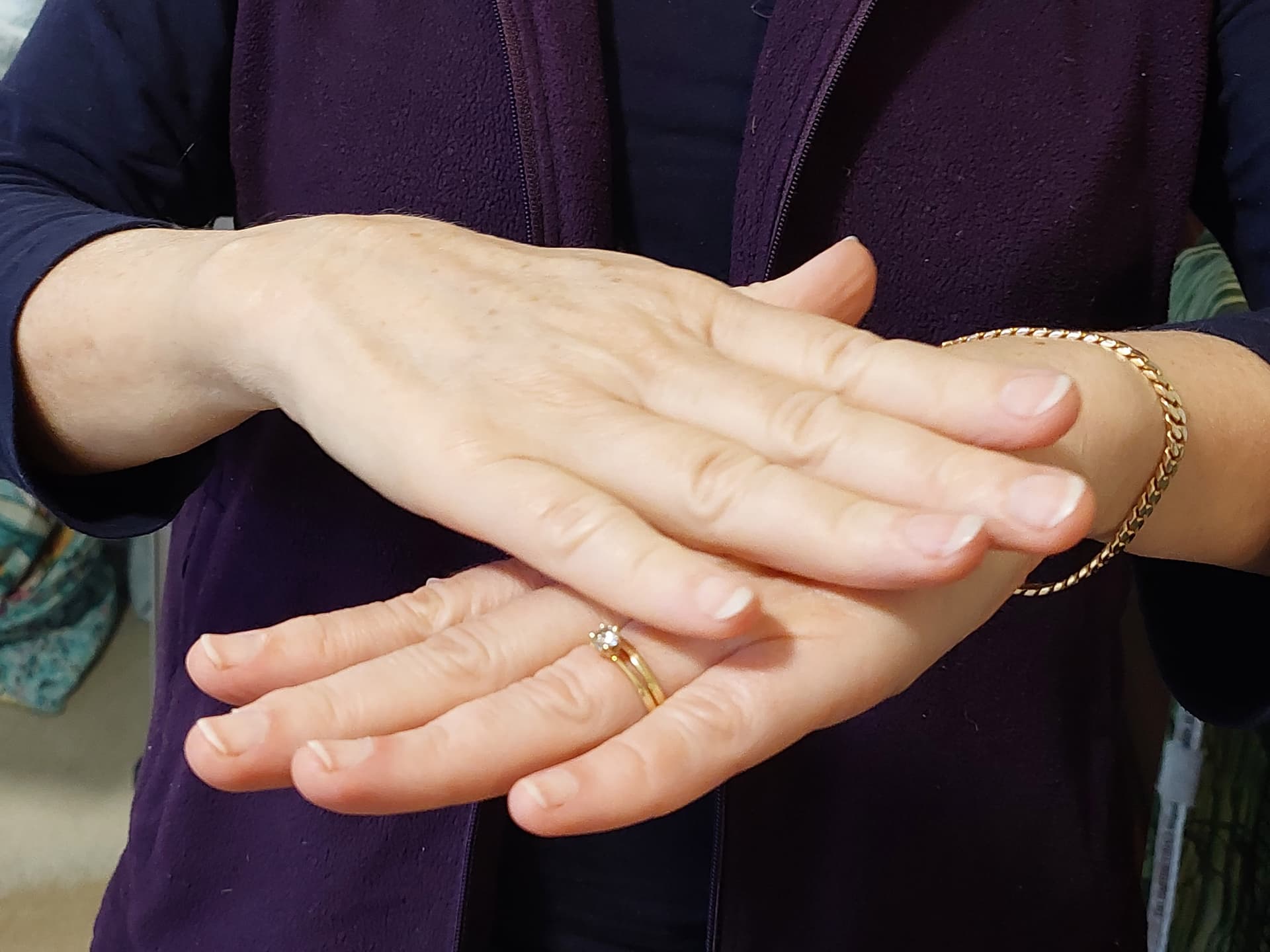
Figure 3: Smooth gesture
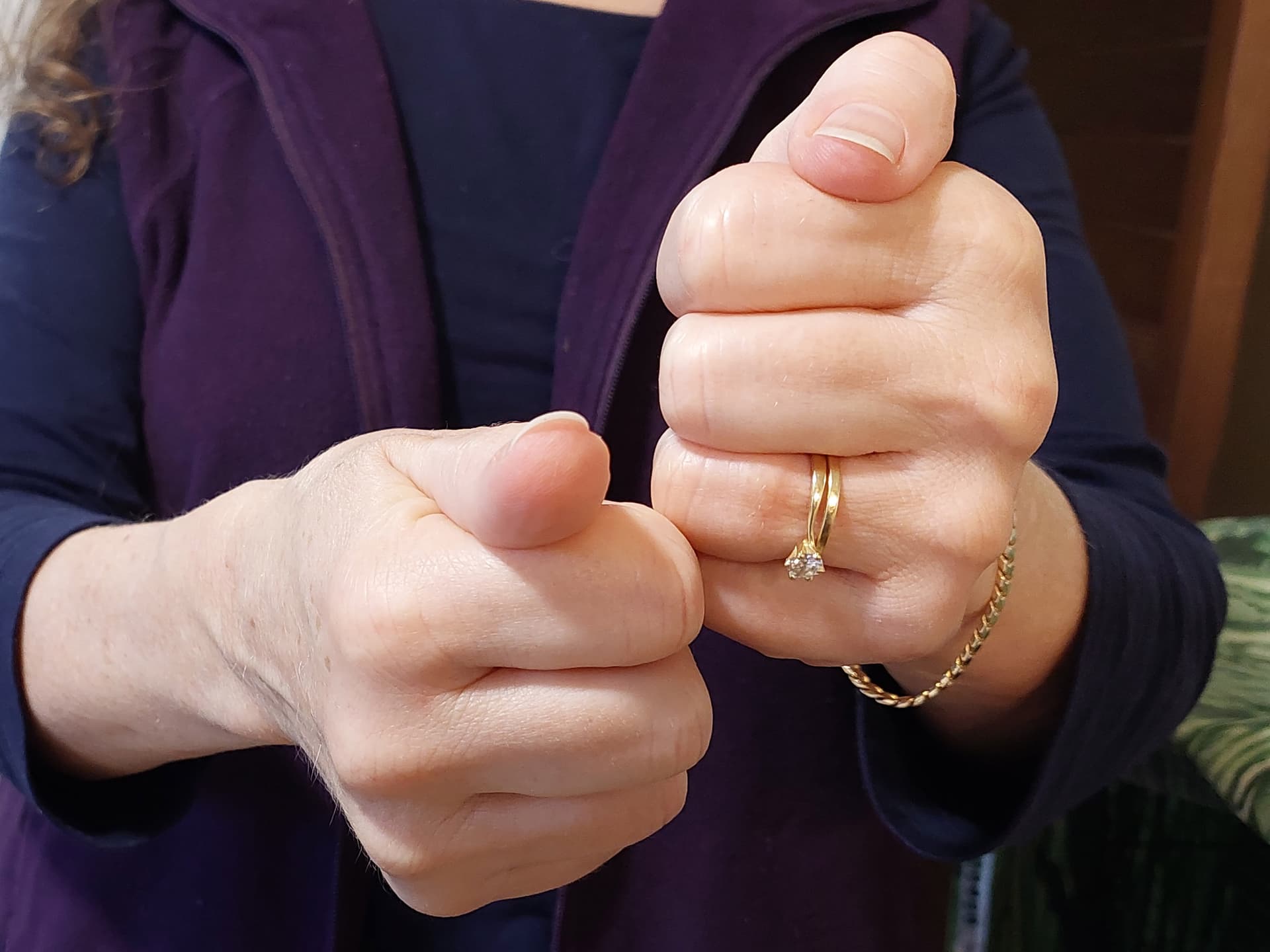
Figure 4: Bumpy gesture
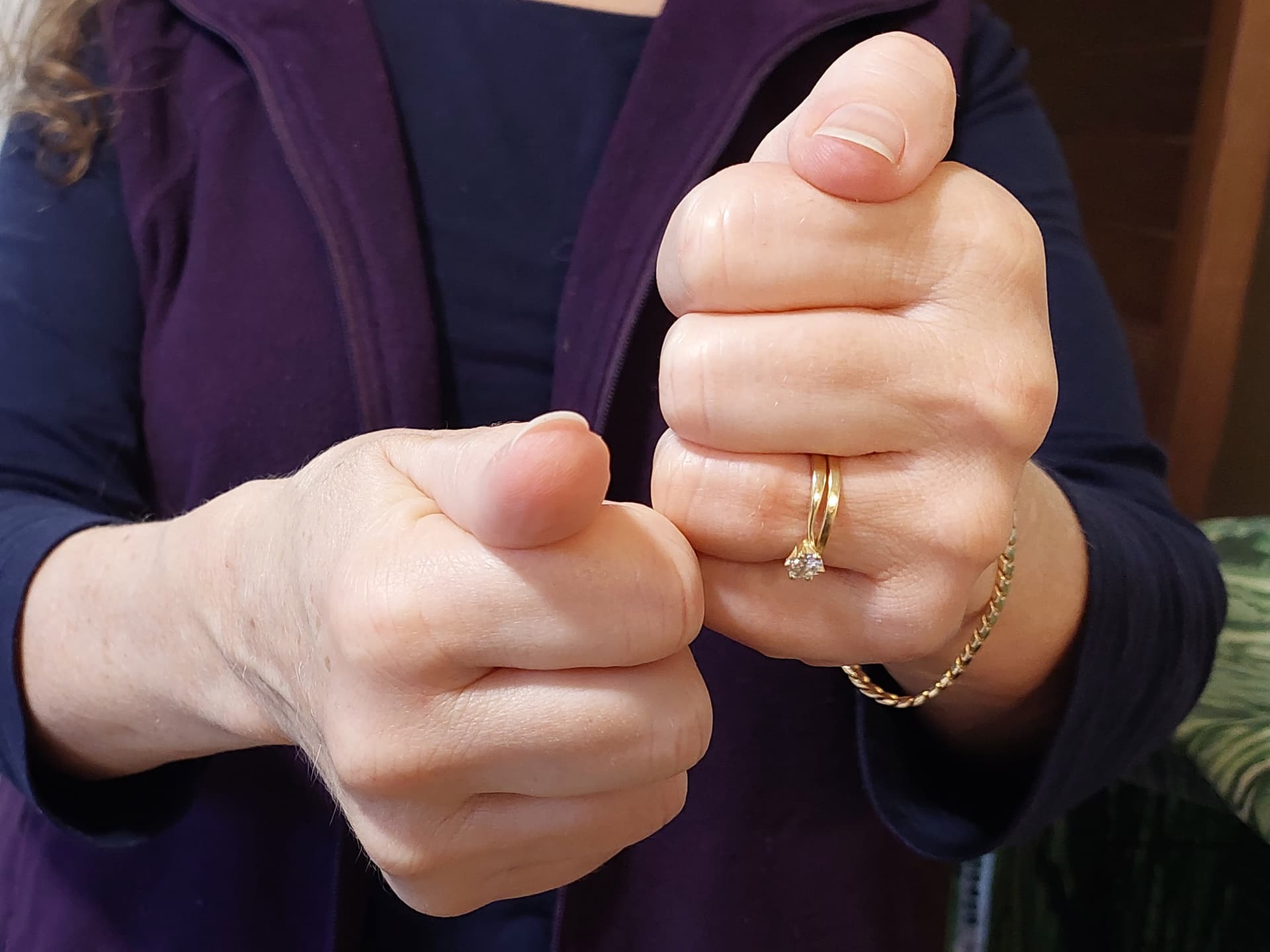
Figure 5: Spongy gesture
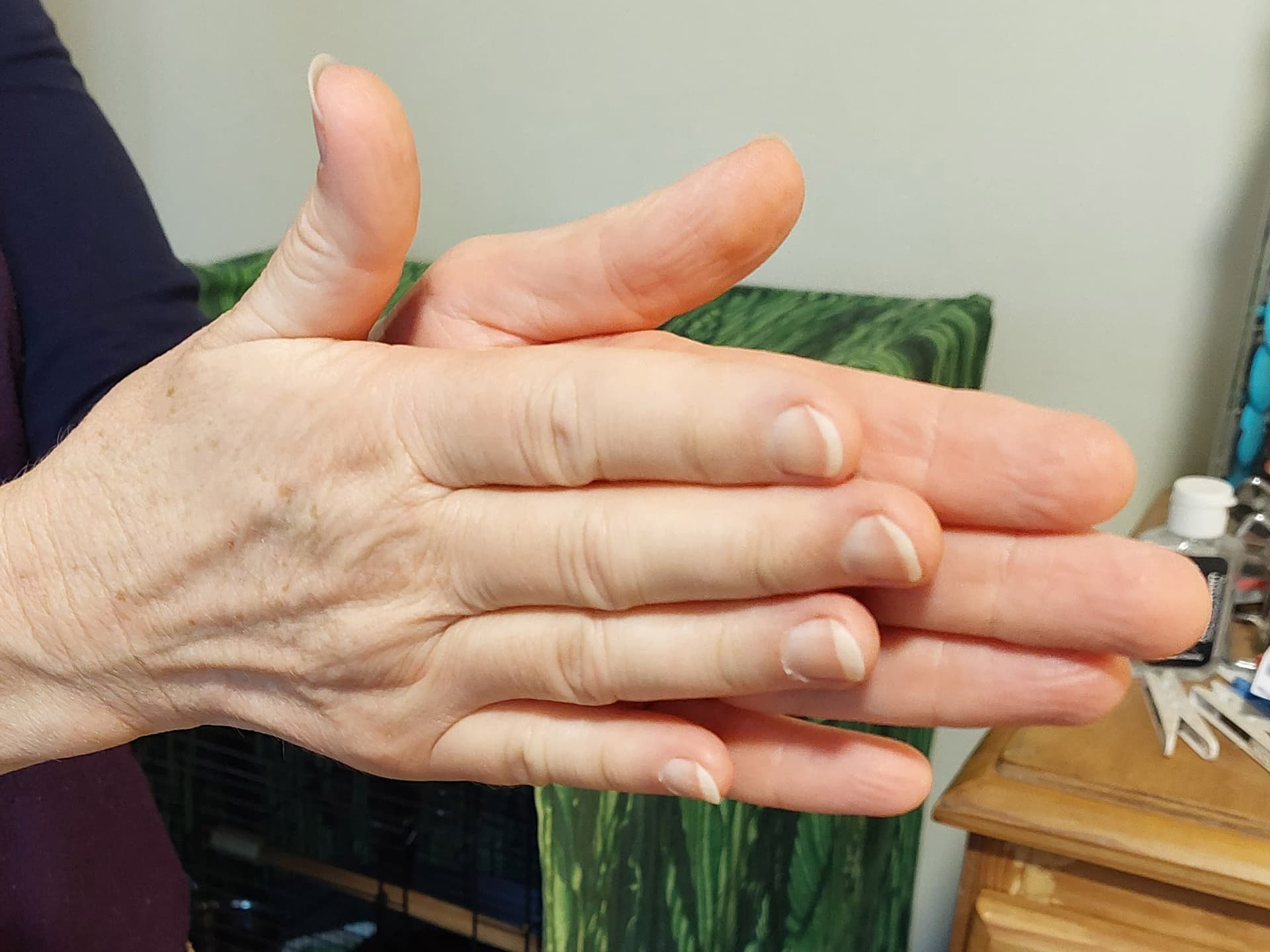
Figure 6 Rough gesture
Representation
Next without looking at their actual object, students will sketch what they think their object looks like based on what they felt.
Sharing and Discussion
After drawings are completed, the teacher reveals the objects from the box and guides the class to discuss:
- What about the object did you feel first?
- How well did your drawing match the object? Why?
- How can the skin sense organ help us learn about something without using eyes?
Extension and Class Reflection
Students reflect on the activity by comparing different objects and discuss why certain textures may feel different from others.
Teacher guides students to link textures to uses of materials with real-life examples:
- Rough: improves durability (handles, stones)
- Soft: provides comfort (blankets, stuffed toy)
- Spongy: provides cushioning (pillows, sponge)
Safety considerations
- Box must contain safe, clean and non-sharp objects
- Use hand sanitiser before touching objects
Pedagogy
Embodied learning is a pedagogical tool that transforms concepts into tangible ideas for stage one students (Congdon & Goldin-Meadow, 2021). When students physically act out that light must enter the eye to enable vision, use gestures to represent different textures or enact how sound vibrations are captured by our ears to enable us to hear, they are actively thinking as they move their bodies. This aligns with Vygotsky's constructivist theory (McLeod, 2025). highlighting how movement and doing are directly linked with cognitive development and heightened memory retention rates (Macedonia, 2019). Embodied learning is also an accessible learning pedagogy that follows the principles of the UDL framework (CAST, 2024). The activities described here (and others like them) can foster student engagement that is vital in improving motivation and educational outcomes (Skulmowski & Rey, 2018).
Conclusion
The embodied activities outlined in this article enable stage 1 students to explore how their senses capture certain stimuli that trigger messages to the brain. Through physical engagement and representation of basic parts of sensory organs students can expand their scientific understanding and satisfy their curiosity about how their bodies work. The pedagogical decisions and scaffolding from the teacher supports cognitive, sense making development of young students.
Acknowledgement (Images provided by Chris Preston)
Syllabus Links
ST1-SCI-01
- measures and describes changes in living things, materials, movement, Earth and the sky
Content points
- Recognise that the human brain detects information about the surroundings using sense organs, and that it controls and coordinates body functions, Pose questions, test and describe textures to investigate the sense of touch,
- Observe and describe the function and parts of the eye and the ear
ST1-PQU-01
- poses questions based on observations and information to investigate cause and effect
References
- CAST. (2024). Universal design for learning guidelines version 3.0. https://udlguidelines.cast.org
- Congdon, E. L., & Goldin-Meadow, S. (2021). Mechanisms of embodied learning through gesture and action: Lessons from development. In C. A. Was, F. J. Sansosti, & B. C. Morris (Eds.), Frontiers of cognitive psychology: Cognitive development from a strategy perspective (pp. 429–445). Springer. https://doi.org/10.1007/978-3-030-78471-3_23
- Kontra, C., Goldin-Meadow, S., & Beilock, S. L. (2012). Embodied learning across the life span. Topics in Cognitive Science, 4(4), 731–739. https://doi.org/10.1111/j.1756-8765.2012.01221.x
- Macedonia, M. (2019). Embodied learning: Why at school the mind needs the body. Frontiers in Psychology, 10, Article 2098. https://doi.org/10.3389/fpsyg.2019.02098
- McLeod, S. (2025). Vygotsky’s theory of cognitive development. Simply Psychology. https://www.simplypsychology.org/vygotsky.html
- Skulmowski, A., & Rey, G. D. (2018). Embodied learning: Introducing a taxonomy based on bodily engagement and task integration. Cognitive Research: Principles and Implications, 3(1),
- NSW Education Standards Authority (NESA). (2024). Science and Technology K–6 Syllabus (2024) – Overview. NSW Government. https://curriculum.nsw.edu.au/learning-areas/science/science-and-technology-k-6-2024/overvie w